


How a coordinated legal strategy successfully invalidated a design patent filed by a former employee for a product that had already been commercialized by the company
Background
Chaoshang and Pegasus are affiliated companies under common ownership. The patentee, Ms. Yuan, was a former employee of Pegasus. Following her departure, the parties became involved in a series of legal disputes. Pegasus alleged that Ms. Yuan had breached her non-compete obligations by establishing a competing business in the United Kingdom and diverting customers. The court ultimately ruled in Pegasus’s favor and ordered Ms. Yuan to pay damages. Conversely, Ms. Yuan’s claims for unpaid wages and wrongful termination were dismissed. By the time the present dispute arose, all employment-related litigation between the parties had been fully concluded.
Discovery of the Design Patent
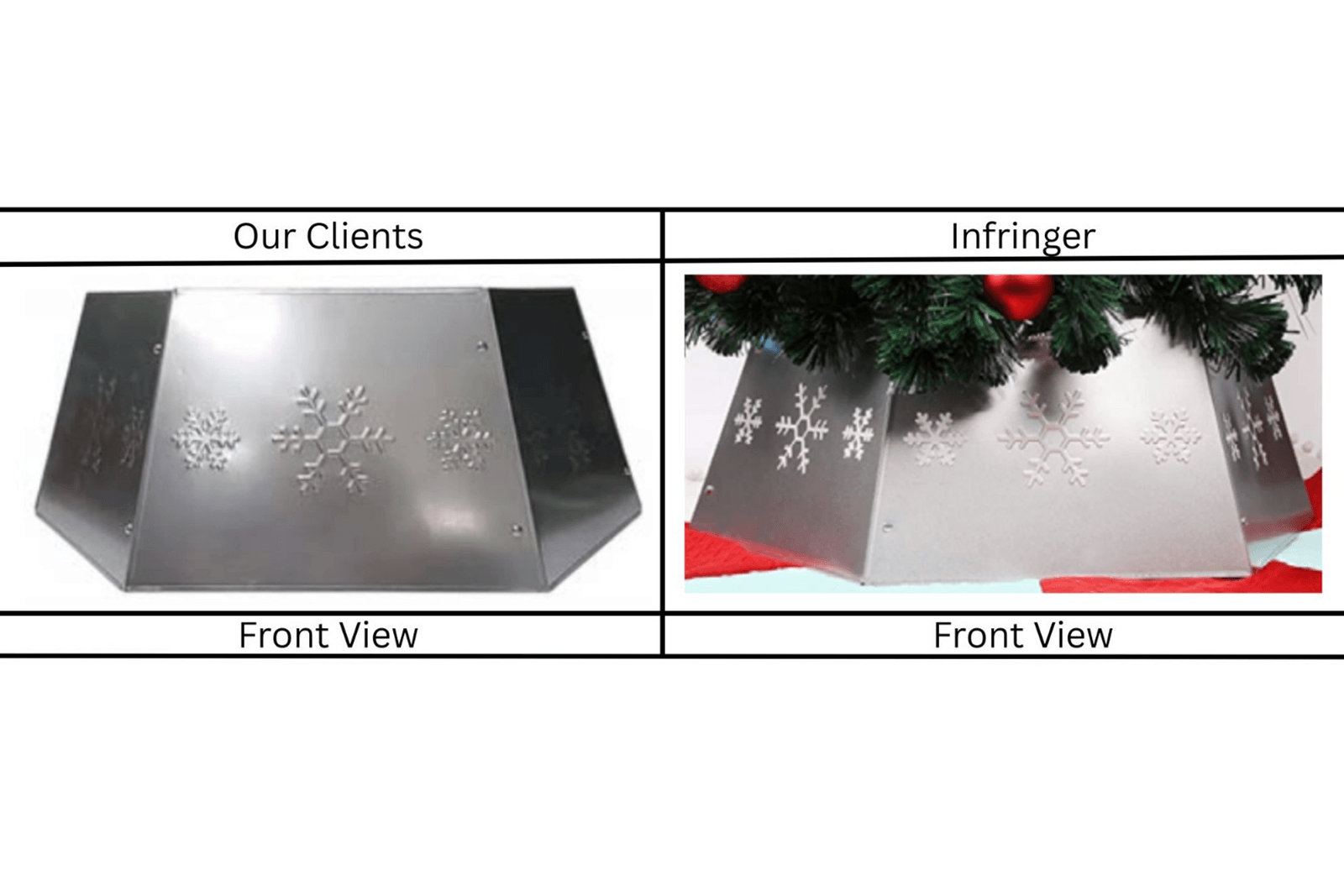
Chaoshang subsequently discovered that Ms. Yuan had filed a design patent application on 27 August 2021 for a six-sided Christmas tree skirt, which was granted by the China National Intellectual Property Administration (CNIPA) on 21 December 2021. Upon comparison, the patented design closely resembled a Christmas tree skirt that Chaoshang had already been selling through an e-commerce platform before the patent’s filing date.
Chaoshang instructed our patent attorneys to file a request for invalidation before CNIPA against Design Patent No. 2021******27.X.
Building the Invalidation Case
The dispute centered on the novelty requirement under Article 23, Paragraph 1 of the Patent Law of the People’s Republic of China, which provides that a granted design must not be identical or substantially similar to a design that had already been publicly disclosed before the filing date.
To establish the lack of novelty, our attorneys submitted archived product listings from the e-commerce platform demonstrating Chaoshang’s prior public sale of the product, together with notarized evidence fixing the publication date and certified Chinese translations. These materials were submitted as Evidence 1 and Evidence 2.
We argued that the patented design was identical to, or at least not substantially different from, the design that had already been publicly disclosed before the filing date. As the earlier design constituted prior public disclosure, the patent failed to satisfy the novelty requirement under Article 23, Paragraph 1 of the Patent Law and should therefore be declared invalid.
CNIPA’s Decision
After reviewing the evidence, CNIPA found that the patented design and the comparison design shared the same overall configuration, identical treatment of the individual design features, and produced substantially the same overall visual effect. From the perspective of an ordinary consumer, the two designs created no material difference in overall visual impression.
Accordingly, CNIPA concluded that the designs were substantially identical. As a result, the patent did not comply with the novelty requirement set out in Article 23, Paragraph 1 of the Patent Law, and Design Patent No. 2021******27.X was declared invalid in its entirety.
Why This Case Matters
E-commerce listings can serve as effective prior art evidence
When properly notarized and accompanied by certified translations, product listings published on e-commerce platforms can constitute persuasive evidence of prior public disclosure in design patent invalidation proceedings before CNIPA.
Employment disputes and IP enforcement are independent legal remedies
The conclusion of employment litigation does not prevent a company from pursuing separate intellectual property remedies when new infringing conduct subsequently comes to light, such as a former employee filing a patent application covering the company’s existing product design.
Ongoing patent monitoring is essential
Former employees or affiliated entities may seek to obtain patent protection for designs developed during their employment. Regular monitoring of newly published patent applications enables businesses to identify potentially problematic filings at an early stage and take timely legal action before those rights become firmly established.
Conclusion
Where a former employee or competitor obtains a design patent covering a product that has already been commercialized by the original business, an invalidation proceeding can provide a swift and effective legal remedy. Success, however, depends upon establishing prior public disclosure through properly preserved and authenticated evidence. By maintaining effective intellectual property monitoring systems and responding promptly to questionable patent filings, businesses can better safeguard the product designs they brought to market first.
Legal References
- Article 23, Paragraph 1 of the Patent Law of the People’s Republic of China requires that a granted design possess novelty and must not be identical or substantially similar to any design that had been publicly disclosed before the filing date.
- CNIPA’s examination practice in design patent invalidation proceedings assesses novelty from the perspective of the ordinary consumer’s overall visual impression. Properly notarized electronic evidence, including online product listings, may be accepted as evidence of prior public disclosure where authenticity and disclosure date are adequately established.