


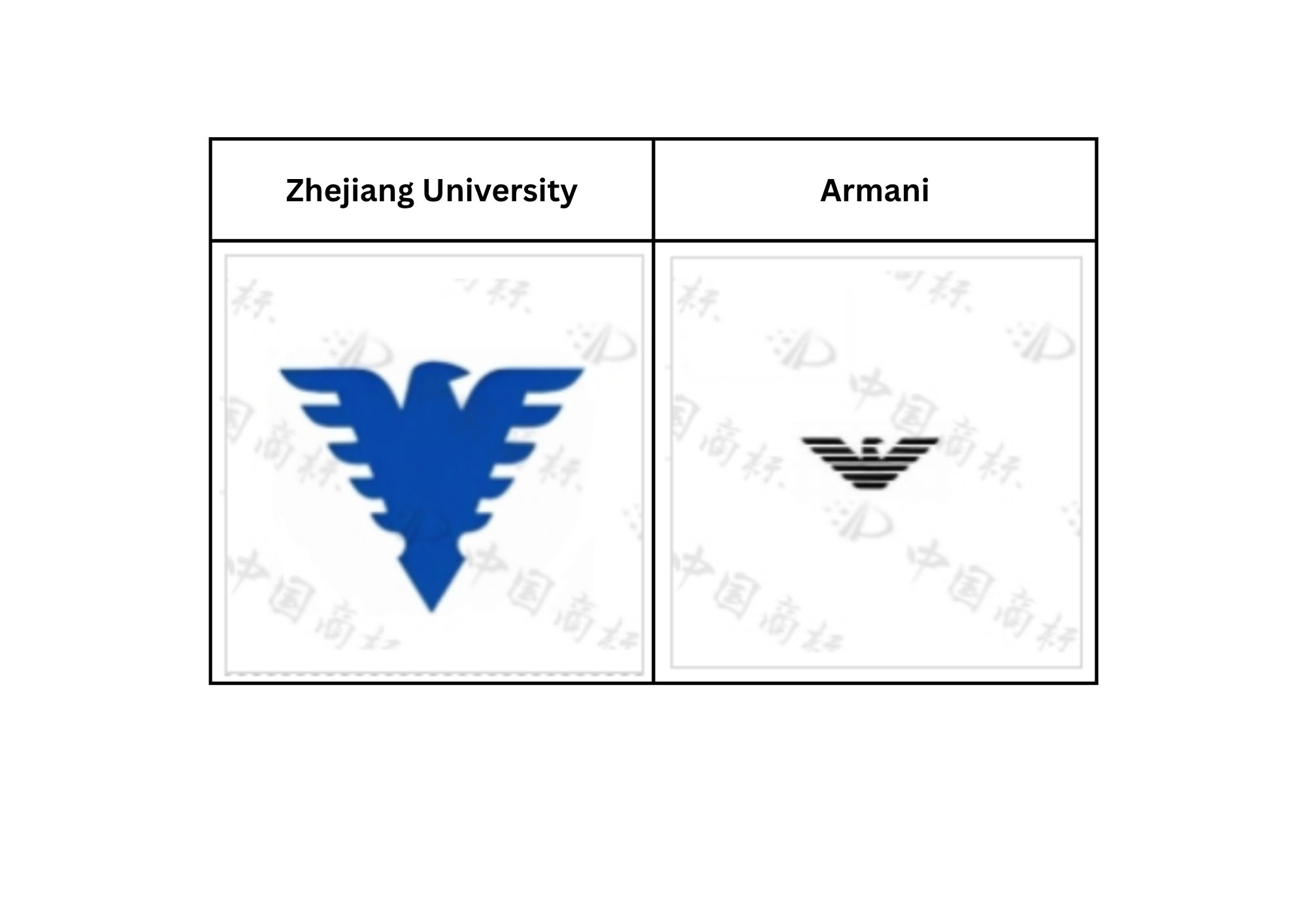
Quick summary: In July 2026, a photo comparison went viral on Chinese social media. It placed Zhejiang University’s “Qiushi Eagle” emblem side by side with the Emporio Armani eagle logo. The internet joked about a trademark showdown. In reality, there is no lawsuit, no complaint, and no legal dispute between the two. The university simply filed a routine registration for its century-old eagle symbol. The timing happened to coincide with a separate, much bigger trademark case that had China talking about logos.
The Viral Comparison That Wasn’t a Lawsuit
A screenshot comparison spread quickly across Weibo in July 2026. It placed Zhejiang University’s Qiushi Eagle (求是鹰) next to the stylized eagle on Giorgio Armani’s Emporio Armani logo. The Qiushi Eagle sits at the center of the school’s emblem. Both marks are dark, angular eagles with wings spread, viewed head-on. The resemblance was enough to send the story climbing China’s hot-search charts.
The joke that followed was predictable. Commenters said one of China’s most prestigious universities had rushed to trademark its own emblem. They joked it wanted to beat an Italian fashion house to the punch.
There’s just one problem with that story: it never happened.
- Armani filed no complaint.
- Armani sent no cease-and-desist letter.
- No litigation exists between the two parties.
In reality, Zhejiang University had simply completed a routine piece of trademark housekeeping. That news became public in the same week a very different, and very real, trademark lawsuit was dominating headlines.
Comparing the Two Trademark Filings
The clearest way to understand what did and didn’t happen is to check the official records. China’s National Intellectual Property Administration (CNIPA) keeps a public trademark database for exactly this purpose.
Armani’s Eagle Trademark
| Detail | Filing Information |
| Registration number | 48801717 |
| Owner | Giorgio Armani S.p.A. (Milan, Italy) |
| Class | 25 , clothing and footwear (sweaters, jeans, swimwear, ski boots, rain gear) |
| Filed | August 10, 2020 |
| Published | November 2021 |
| Registered | February 7, 2022 |
| Protection through | February 6, 2032 |
This is the well-known Emporio Armani eagle. Its wings extend and cross with horizontal lines, and the brand has historically paired it with the “EA” initials.
Zhejiang University’s Eagle Trademark
| Detail | Filing Information |
| Registration number | 89248915 |
| Owner | Zhejiang University |
| Class | 25 , clothing (including waterproof garments, infant sets, footwear, headwear, socks, gloves, belts, wedding dresses) |
| Filed | December 19, 2025 |
| Published for opposition | May 13, 2026 (Announcement No. 1983) |
| Status (as of July 2026) | Cleared preliminary examination |
These are two separate marks, filed more than five years apart by two unrelated owners in two different countries. That’s the full extent of the “conflict.”
The Eagle That Predates the Brand by Decades
Chronology is the most important fact in this story. Chinese media coverage was consistent on this point.
Zhejiang University’s historical records trace the Qiushi Eagle motif back to the school’s seal from the late 1920s. At the time, the school went by the name National Chekiang University. The university then:
- Formally re-established the eagle as the centerpiece of its badge in a 1990 redesign
- Digitally refined the design in 2017 for its 120th anniversary
By contrast, Giorgio Armani founded his fashion house in 1975. That’s decades after the Qiushi Eagle first appeared on the university’s seal. That’s precisely why online reaction skewed toward mockery. The joke became “Armani should worry about Zhejiang University” , not the other way around. Some social media users went further. They argued that any legal claim would logically favor the university, not Armani. After all, the university’s use of the eagle is far older.
None of this means either mark is “wrong” to exist. Trademark law typically grants rights by class of goods and jurisdiction, not by who drew a similar eagle first. But the origin timeline still matters. It’s exactly the kind of documentation that counts if a genuine dispute ever arises. We’ll return to that point below.
Why the Timing Looked Suspicious (But Wasn’t)
This story exploded online in July 2026 for one specific reason. It landed in the middle of an unrelated, much bigger trademark case.
On June 29, 2026, the Suzhou Intermediate People’s Court ruled on a trademark case. Louis Vuitton had sued the Chinese milk-tea chain Molly Tea (茉莉奶白) for infringement. The court found that Molly Tea’s four-petal flower logo infringed seven of LV’s registered trademarks. It ordered the chain to pay roughly 10.3 million yuan (about US$1.5 million) in damages. Molly Tea had tried to register its own version of the flower design in 2024, but CNIPA rejected the application. That meant the chain had no defensible mark of its own when LV sued. The company said it would appeal.
The ruling triggered a national conversation about who owns which logo. In that charged atmosphere, someone noticed the resemblance between the university’s emblem and Armani’s eagle. The story took off from there.
What the University’s Trademark Agent Actually Said
Chinese financial outlet Yicai (第一财经) tracked down Zhang Yifeng, the university’s trademark agent at Hangzhou Henghui Trademark Affairs Firm. Zhang explained that:
- Zhejiang University already held a trademark for its full circular school badge, complete with text and the founding year 1897.
- It had never separately registered the isolated eagle graphic on its own.
- The university filed the standalone eagle application at the end of 2025 , months before the LV–Molly Tea verdict.
- The real motivation: small vendors had been printing eagle graphics that resembled the university emblem. They put these on caps, souvenirs, and consumer goods to imply an official school endorsement that didn’t exist.
Multiple outlets , including a follow-up Yicai/163 report and Sina Finance , independently confirmed the paper trail. The batch of eagle-graphic trademarks carried sequential application numbers. That shows the university filed them together as a single series months earlier. It did not hastily assemble them in response to the LV ruling.
The filings simply moved through China’s standard trademark pipeline: application, substantive examination, then preliminary publication. That process typically takes seven to eight months. That pipeline happened to conclude on July 6, 2026, the same week the LV ruling went viral. That coincidence of timing , not any actual rush , created the appearance of a defensive land grab.
A Two-Decade Pattern, Not a One-Off
This also isn’t the university’s first move to protect its identity. Back in 2004, Zhejiang University filed for comprehensive protection across four marks: “Zheda,” “Qiushi,” “ZHEDA,” and the eagle graphic. The push ultimately registered roughly 180 trademarks across 45 commercial classes. Reports called it a national first for a Chinese university at the time. Some accounts place the university’s very first full-class filing as early as 2002.
The pattern is consistent. This school has an unusually long, well-documented history of proactively registering its own name and symbols. Professional trademark counsel handled these filings long before any Armani comparison entered the picture.
Why Visual Similarity Alone Doesn’t Equal Infringement
Trademark law generally asks a narrower question than “do these two logos look alike?” Examiners and courts assess whether a mark is likely to cause consumer confusion. They look at the specific classes of goods where the owner has registered each mark. They also weigh each party’s reputation, prior use, and distinctiveness.
- A stylized eagle on a Chinese university’s official crest , used in an educational and campus-merchandise context, with a documented lineage stretching back nearly a century.
- A stylized eagle on an Italian sportswear line, sold through fashion retail channels since the 1970s.
These occupy very different commercial spaces, even if a screenshot makes them look alike at a glance. Legal commentary on the episode converged on the same point. Visual resemblance alone does not establish a legal conflict. That requires overlapping markets, or evidence that one side is trading on the other’s reputation. Two similar-looking marks with clearly separate origins and audiences can coexist without either being at risk.
Liu Wei, a tenured professor at Tongji University’s Shanghai International College of Intellectual Property, explained that full-class trademark registration is fundamentally a defensive strategy for universities. It builds a protective perimeter around an institution’s name and symbols before third parties can exploit them. China has taken steps to curb bad-faith trademark squatting. Even so, filing early and comprehensively across relevant classes remains the most reliable safeguard for any brand or institution.
The Real Lesson: Register Early, Register Broadly
Strip away the Armani headline, and the lesson here is simple. Prior use and prior registration form the foundation of trademark protection. The burden of proving them falls on whoever wants to assert a right.
Zhejiang University could credibly wave off online speculation about an Armani conflict. That’s not because its eagle looks different enough. It’s because the university can point to a documented, traceable history:
- A 1920s seal
- A formal 1990 redesign
- A 2017 digital refinement
- A paper trail of trademark filings dating back to the early 2000s across dozens of commercial classes
The same principle explains the opposite outcome in the Molly Tea case. Molly Tea’s four-petal flower design lost in court. Part of the reason: the company had tried and failed to register its own version of the mark in 2024. That left the company with no independent registered right to rely on. Louis Vuitton, holding seven registered marks in the relevant classes, brought its infringement claim anyway.
Two brands, two very different outcomes , and the difference wasn’t about how similar the logos looked. It came down to who filed the paperwork, and when.
Key Takeaways for Brands and Institutions
- Register early. A filing date is your strongest piece of evidence in any future dispute.
- Register broadly. Cover the commercial classes where your brand might realistically expand or be imitated.
- Document your history. Keep clear records of your mark’s origin and use , old seals, redesign dates, and prior filings all matter.
- Don’t assume visual similarity equals infringement. Courts look at consumer confusion within specific goods classes, not just side-by-side appearance.
- A viral photo isn’t a legal case. Only registration certificates, filing dates, and documented use hold up when it counts.
In the end, the Qiushi Eagle and the Armani eagle are simply two marks. Two entirely unrelated owners filed them decades apart. Each has a legitimate claim to its own corner of the marketplace.
Frequently Asked Questions
Is Armani suing Zhejiang University over its eagle logo? No. There is no lawsuit, complaint, or legal dispute between Armani and Zhejiang University. The comparison was a viral social media observation, not a legal action.
Did Zhejiang University just trademark its eagle logo to avoid an Armani lawsuit? No. The university filed the standalone eagle trademark in December 2025. The goal: stop unauthorized vendors from printing similar eagle graphics on unofficial merchandise, not respond to Armani.
Which eagle logo came first, Zhejiang University’s or Armani’s? Zhejiang University’s Qiushi Eagle dates back to the school’s seal from the late 1920s. Giorgio Armani founded his fashion house in 1975, decades later.
Why did this story go viral in July 2026? It coincided with an unrelated Louis Vuitton trademark lawsuit against Chinese milk-tea chain Molly Tea. That case put trademark and logo ownership in the news that same week.