


A legal analysis by Tranfan Law Office
Introduction
On July 14, 2026, a headline swept across Chinese social media and even reached official accounts: “LV is suing the National Intellectual Property Administration.” Within hours, the story had gone viral, with many outlets , and even more commentators linking it to Louis Vuitton’s separate, high-profile trademark infringement win against bubble tea brand “Molly Milk White” weeks earlier. The implication many readers took away was dramatic: that LV, having already won a multi-million-yuan judgment against a domestic tea brand, was now escalating its trademark enforcement campaign to take on the Chinese government itself.
The reality is both less dramatic and, for anyone working in intellectual property law, considerably more instructive. This case is not a continuation of the Molly Milk White dispute. It is a separate administrative proceeding, arising from a different trademark, involving a different party, and turning on a different legal question. But understanding why the confusion happened , and what actually occurred , offers a valuable case study in how trademark enforcement, administrative review, and public perception can collide.
This article lays out the full background of the dispute, the parties involved, the trademark at the center of the case, CNIPA’s ruling, and what LV’s lawsuit against CNIPA actually means , both legally and for brand owners operating in China .
Background: Who Is Huang Minyao?
The case that will be heard by the Beijing Intellectual Property Court on July 16, 2026 (case number (2026) 京73行初4727号) centers on a trademark filed not by a company, but by an individual: Huang Minyao, a garment-industry entrepreneur registered in Luoding, Guangdong Province.
Public records show that Huang has been an active trademark filer. Since 2023, he has personally submitted more than 100 trademark applications covering various goods and services. This is not, on its own, unusual , individual entrepreneurs in China’s manufacturing and retail sectors frequently register trademarks to protect their own product lines, particularly in competitive industries like apparel and accessories.
Of Huang’s filings, eight drew formal opposition from Louis Vuitton after they passed initial examinations or were registered. LV’s opposition and invalidation requests are, in the world of luxury brand enforcement, a routine defensive measure , global fashion houses monitor new trademark filings closely and challenge any mark they believe is confusingly similar to their own protected designs.
Of those eight contested marks, LV succeeded in seven , CNIPA sided with LV and refused registration on those applications. On the eighth, however, the outcome was different, and this is the mark that sits at the heart of the current dispute.
The Disputed Trademark: Registration No. 75036701
The trademark in question , officially Registration No. 75036701 , was filed by Huang Minyao on November 7, 2023, and registered on May 14, 2024, with protection extending to May 13, 2034. It is registered in Nice Classification Class 18, covering goods such as travel bags, briefcases, backpacks, handbags, shopping bags, and wallets , precisely the category of goods most associated with Louis Vuitton’s own product lines, which is likely why LV’s enforcement team flagged it in the first place.
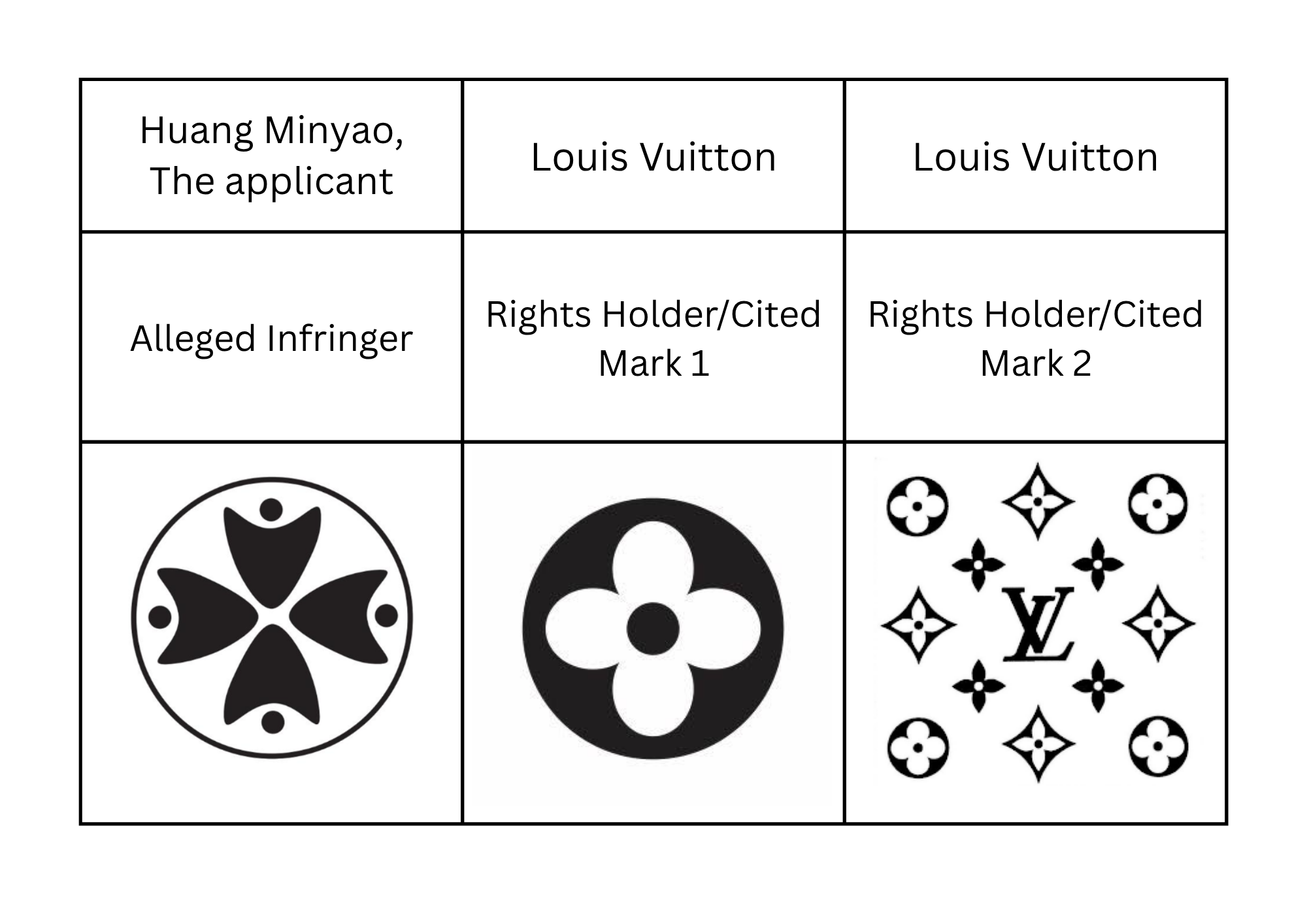
Visually, the mark is a circular figurative design: within a thin circular border, four curved, symmetrical shapes radiate outward from a central point in a cross-like arrangement, with four small accent dots positioned between them at the cardinal points. Some Chinese media described the shapes as resembling stylized fish; others characterized the overall composition as a four-lobed floral or petal motif. Both descriptions capture different aspects of a genuinely distinctive design , one built around a circular frame, sharp curved lines, and a geometric symmetry that gives it a fairly different visual character from typical floral trademark designs.
LV’s Invalidation Request
In December 2024, Louis Vuitton Malletier filed a formal invalidation request with CNIPA, seeking to have Huang’s mark cancelled. LV’s argument rested on two cited trademarks of its own:
- A four-petal floral graphic mark, filed by LV on August 9, 1996, also registered in Class 18.
- LV’s well-known monogram canvas pattern, combining stylized quatrefoil and floral motifs interspersed with the brand’s initials, filed on February 18, 1985, and also protecting Class 18 goods.
LV argued that Huang’s circular fish/petal design was confusingly similar to these two long-established, extensively used marks, and that allowing it to coexist in the marketplace risked consumer confusion , particularly given that LV’s monogram pattern has, through decades of use on bags, luggage, and leather goods, achieved a very high degree of public recognition in China. LV further argued that Huang’s broader pattern of trademark filings , many bearing some visual resemblance to LV’s own registered marks , suggested bad-faith registration rather than genuine, independent brand-building.
CNIPA’s Ruling: A Rare Loss for LV
CNIPA’s review process for invalidation requests is thorough, typically involving a side-by-side comparison of the graphic elements, an assessment of the goods and services involved, and , particularly relevant in cases touching on traditional or widely-used decorative patterns , consideration of whether the design elements in question are common or public-domain motifs rather than source-identifying features unique to one brand.
After conducting this review, CNIPA rejected LV’s invalidation request. The agency’s ruling found that Huang’s circular fish/petal design and LV’s cited marks were not confusingly similar, despite both being figurative marks used on the same category of goods. CNIPA’s decision effectively upheld Huang’s registration as valid.
This outcome stands in contrast to the seven prior cases in which CNIPA sided with LV against other marks filed by Huang, and it illustrates a point worth emphasizing for brand owners: trademark opposition and invalidation outcomes are not simply a function of the size or fame of the challenging brand. Each case turns on the specific visual comparison and legal standard applied to that particular mark, and even the most aggressive and well-resourced enforcement programs will lose a meaningful share of the individual proceedings they bring.
LV’s Response: Suing CNIPA, Not Huang Minyao
This is the point in the story where public understanding diverged sharply from legal reality, so it is worth stating plainly: Louis Vuitton has not sued Huang Minyao. There is no infringement lawsuit against him, no claim for damages, and no allegation that he has sold or marketed goods bearing his registered mark in a way that violates LV’s rights.
What LV has done is exercise a separate and entirely standard legal right: the right to challenge an adverse decision by CNIPA before the courts. Under China’s Trademark Law, any applicant, registrant, or interested party who disagrees with a CNIPA ruling , whether it’s a refusal to register a mark, an invalidation decision, an opposition ruling, or, as in this case, a refusal to invalidate someone else’s registration , may file an administrative lawsuit against CNIPA before the Beijing Intellectual Property Court, which holds exclusive jurisdiction over first-instance trademark and patent authorization and confirmation disputes nationwide.
In this proceeding, Louis Vuitton Malletier is the plaintiff, CNIPA is the defendant, and Huang Minyao participates only as a third party , because the outcome of the case will directly affect the validity of his registered trademark, even though he is not the one being sued. The central legal question before the court is narrow and technical: was CNIPA’s decision not to invalidate Huang’s mark legally correct? The court will not be asked to determine whether Huang infringed LV’s rights through commercial use of the mark; that is a different type of proceeding entirely, and there is no indication one has been filed.
Not LV’s First Time Suing CNIPA
Contrary to the “escalation” narrative that spread online, this is far from an unprecedented move by LV. Public court records indicate that this is at least the sixth time Louis Vuitton Malletier has filed suit against CNIPA in a first-instance trademark administrative case. Of five prior cases with published outcomes, LV prevailed in three , with the court ordering CNIPA to reconsider its original decision , and lost two, with the court upholding CNIPA’s original ruling.
These prior cases illustrate the range of circumstances under which LV has taken CNIPA to court, including disputes over LV’s own trademark applications being refused (such as a 2020 case involving the mark “ATTRAPE-RÊVES,” where CNIPA found it too similar to a pre-existing Chinese-language mark), and cases , like the current one , where LV sought to invalidate a third party’s registration and was unsuccessful before CNIPA.
Beyond these formal administrative lawsuits, LV’s broader trademark enforcement footprint in China is substantial. Corporate registry data shows that searches for “Louis Vuitton Malletier” combined with “trademark infringement” return approximately 1,691 risk-flagged legal actions over the past five years, with 56 new filings recorded in just the first half of 2026. LV currently holds more than 880 registered trademarks in China related to its brand name and monogram design, alongside 138 trademark applications that have been refused or invalidated.
Seen against this backdrop, a single administrative appeal against CNIPA , even one involving a widely recognized global brand , is a routine, unremarkable event within LV’s ordinary course of trademark portfolio management. Legal commentators have been quick to make this point in response to the online furor, noting that filing suit against CNIPA when an administrative decision goes against you is a lawful and common recourse, not an aggressive escalation, and certainly not evidence of any special treatment or “overreach” on LV’s part.
Why the Confusion Happened
Given how routine this type of filing actually is, why did it generate such intense public reaction? The timing offers the clearest explanation.
Approximately two weeks before this case surfaced, LV won a first-instance judgment against Molly Milk White, a Chinese bubble tea chain, in the Suzhou Intermediate People’s Court. That case found Molly Milk White’s four-leaf floral logo infringed seven of LV’s registered graphic trademarks, and ordered the company to pay LV approximately RMB 10.3 million in damages and legal costs, along with public corrective statements across major social platforms. Molly Milk White’s founder publicly stated the company would appeal.
That case generated substantial public debate , not only about the specific infringement finding, but about broader questions of whether decorative patterns with roots in traditional or widely-used design vocabulary should be subject to exclusive private ownership through trademark registration. A commentary published by a People’s Daily-affiliated platform even weighed in, suggesting that trademarks built on public cultural resources or generic design elements should receive a narrower scope of protection than fully original marks.
Against that backdrop of heightened scrutiny and brand-related sentiment, the appearance of a new court filing bearing LV’s name and a government agency as defendant was primed for viral misinterpretation , especially once media coverage began implying a connection between the two cases that did not, in fact, exist.
Key Takeaways for Brand Owners
This case offers several practical lessons for companies managing trademark portfolios and enforcement strategy in China:
- Administrative litigation against CNIPA is a normal part of trademark practice. Rights holders , foreign and domestic alike , regularly challenge CNIPA rulings they disagree with. This is not confrontational in any unusual sense; it is how the statutory review system is designed to work, and CNIPA faces tens of thousands of such first-instance cases annually across all applicants.
- Winning most opposition or invalidation cases does not mean winning all of them. Even a brand with the resources and legal sophistication of LV will lose a meaningful percentage of individual proceedings , as illustrated by LV’s 3-2 record in prior CNIPA lawsuits, and its loss on one of eight contested marks in the Huang Minyao filings.
- Distinguishing administrative disputes from infringement disputes matters. An administrative case testing whether a government ruling was legally correct is a fundamentally different proceeding from a civil infringement lawsuit seeking damages from an alleged infringer. Conflating the two , as much of the public discourse around this case did , creates a misleading picture of what is actually at stake and for whom.
- Public sentiment can outpace legal substance quickly. When a brand is already under scrutiny for one dispute, unrelated but superficially similar filings can be swept into the same narrative. Companies with active, high-profile enforcement programs should anticipate this risk and be prepared to clarify the record when misinformation begins to spread.
Conclusion
The July 16 hearing will not resolve any question of infringement, nor will it determine whether Huang Minyao’s business practices were appropriate. It will resolve a single, narrow legal question: whether CNIPA correctly applied the law when it declined to invalidate a circular, four-lobed trademark registered by an individual entrepreneur in Guangdong. Whatever the outcome, it will add one more data point to LV’s long and largely successful record of trademark enforcement in China , a record built not on singular dramatic confrontations, but on the steady, procedural, and often unremarkable work of managing a global brand’s intellectual property across thousands of individual filings.
For brand owners navigating China’s trademark system, the real lesson of this episode isn’t about Louis Vuitton at all , it’s about the value of understanding the legal mechanics behind the headlines before drawing conclusions from them.
Tranfan Law Office advises clients on trademark prosecution, opposition, and enforcement strategy across major jurisdictions, including China. If your business is navigating a trademark dispute or seeking to strengthen its brand protection strategy, contact our team to discuss how we can help.