


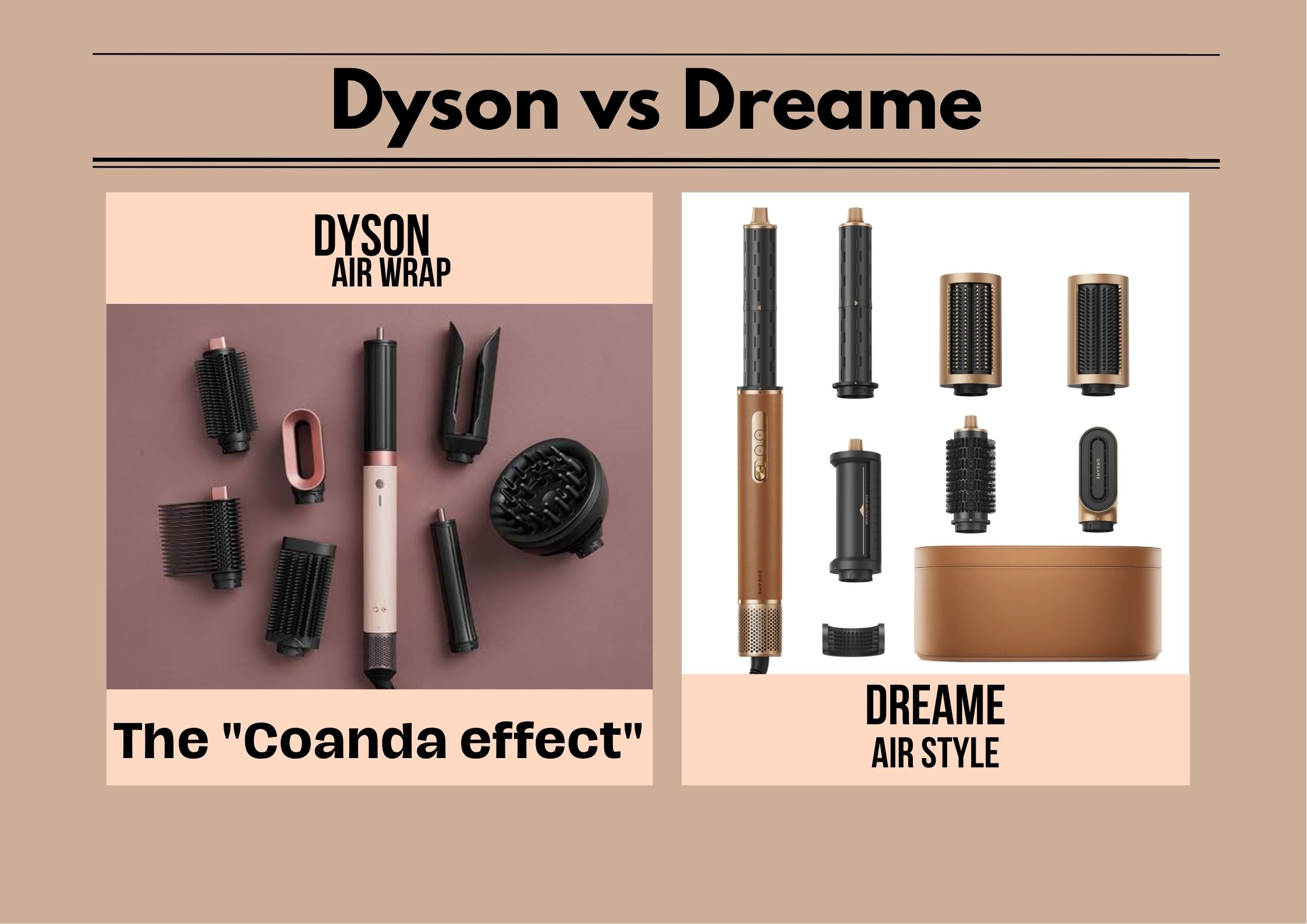
A British hairdryer patent is not where you’d expect to find the future of EU-China trade law being decided. But on March 6, 2026, a panel of judges at the Unified Patent Court’s Court of Appeal did exactly that and in the process, handed Europe’s newest, least-tested court system its first-ever trip to the bloc’s highest tribunal.
The case is Dyson v. Dreame. The patent is EP 3 119 235, the so-called “Coandă Effect” mechanism that lets Dyson’s Airwrap curl hair using looping airflow instead of heat. The defendant is Dreame, a fast-growing Chinese appliance maker based in Suzhou with a Hong Kong sales arm. And the question now sitting in front of the Court of Justice of the European Union is deceptively simple: how far can European courts reach outside Europe to stop a Chinese manufacturer from selling a product that never touched an EU factory floor?
That question arrives at a moment when Brussels has never been more interested in the answer.
What actually happened on March 6
Strip away the procedural language, and the UPC Court of Appeal did two things at once.
First, it widened an existing injunction. Dreame had already been barred, since a Hamburg Local Division ruling in August 2025, from selling its older Airstyle and Pocket stylers across UPC member states. The Court of Appeal extended that ban to newer Dreame devices models the company had apparently redesigned specifically to route around the original ruling. According to legal trackers following the case, the appellate panel found it more likely than not that the redesigned products still infringed, and gave Dreame roughly a month before the wider ban took effect.
Second and this is the part patent lawyers are actually excited about when the court punted a genuinely novel legal question to Luxembourg. The defendants in the case aren’t just Dreame’s Hong Kong manufacturing entity. They also include Eurep GmbH, a small German company whose only role is serving as Dreame’s “authorised representative” a purely administrative position that EU product-safety law requires non-EU manufacturers to appoint before they can legally sell hairdryers in Europe at all. Eurep doesn’t make, market, or sell a single Dreame product. It exists on paper so Dreame can comply with EU labeling and safety rules.
Dyson’s lawyers argued that Eurep’s mere presence in Germany was enough to “anchor” the whole case in EU courts, dragging the Hong Kong parent company along with it and that Eurep itself counts as an “intermediary” whose compliance services could be treated as facilitating infringement. If the CJEU agrees, virtually every non-EU manufacturer selling anything in Europe as a legal requirement, not a choice, would become instantly and permanently exposed to EU courts through that single regulatory foothold. If the CJEU disagrees, the UPC’s ambitions to become a serious global patent enforcement venue take a real hit, since much of its appeal rests on exactly this kind of long-arm reach.
Either way, a CJEU preliminary ruling typically takes one to two years. Dreame will spend that time selling redesigned products under an injunction, appealing, and presumably redesigning again a pattern that, as this article will get to, is not new.
This is not Dyson and Dreame’s first fight. It’s not their fifth.
Anyone reading the March ruling as an isolated legal skirmish is missing the plot. Dyson and Dreame have been suing each other, more or less continuously, since 2020.
The opening skirmish was almost comically reversed from where things stand now: in 2020, Dyson sent warning letters accusing Dreame’s V9 and V10 vacuums of patent infringement and pressured Amazon to pull Dreame’s listings. Dreame sued Dyson in Germany over the warning letters themselves and won. German courts found no infringement and ordered Dyson to stop threatening Dreame’s retailers.
By 2022, the fight had scaled up dramatically, moving to China’s Supreme People’s Court, with Dyson alleging infringement of its vacuum patents. What’s notable is how that round ended: not with a verdict, but with a mediated package settlement covering more than 20 IP-related cases filed both in China and other countries, announced in September 2023. Both sides published warm letters of appreciation. The two sides agreed that they would fully communicate and negotiate rather than directly initiate lawsuits over patent-related problems going forward, according to China’s state court reporting on the deal.
That truce lasted about a year and a half. By May 2025, Dyson was back in court, this time at the UPC, seeking a preliminary injunction against Dreame’s hair stylists. The pattern since then has been almost mechanical: Dyson sues, wins a partial injunction, Dreame tweaks the product design, Dyson sues again over the tweaked version, and the cycle repeats. In April 2026, barely a month after the CJEU referral, the Hamburg Local Division granted Dyson yet another preliminary injunction this time against a Dreame product called the “Dazzle Hair Styler” while simultaneously narrowing the “anchor defendant” theory Dyson had relied on, ruling that an authorised representative appointed purely for cross-border regulatory reasons couldn’t be used to drag in an unrelated UK distributor.
So even as Dyson wins battle after battle, the underlying legal question of how far its wins can reach keeps getting relitigated, narrowed, and appealed. That’s not the profile of a company that has “beaten” a copycat. It’s the profile of two companies fighting a war of attrition that neither has the incentive to actually end because for Dyson, every injunction generates headlines about Chinese IP theft, and for Dreame, every redesign is cheap enough to be worth doing again.
Dyson’s playbook: this is not new, and it’s not just about China
James Dyson has spent two decades building a reputation as one of the most litigious inventors in consumer electronics, and the target has rarely been exclusively Chinese. Dyson has sued Hoover and Amway over cyclone vacuum technology in the UK and US, taken on Vax in years of overlapping suits, and fought Samsung and LG Korean giants, not Chinese ones over vacuum and steam-mop patents.
Its highest-profile recent fight was with SharkNinja, the US-based owner of the Shark brand, in a dispute that stretched from an initial design-patent loss for Dyson in 2018 all the way through a sprawling 2023–2024 sequel covering hair stylers and cordless vacuums across the US, Germany, France and Korea. That fight arguably Dyson’s most expensive and most publicly damaging, given SharkNinja’s own countersuit and a 2018 summary-judgment loss for Dyson ended in a comprehensive settlement in January 2025 that resolved everything at once, reportedly valued in the region of $200 million.
The lesson from the SharkNinja saga is worth sitting with: Dyson’s litigiousness isn’t a China strategy. It’s a company strategy, deployed against Western and Asian rivals alike, arguably as central to Dyson’s competitive positioning as its actual engineering. What’s different about the Dreame fight is not Dyson’s behavior, it’s the backdrop it’s now playing out against.
James Dyson himself has been unusually blunt about the China piece specifically, publicly and repeatedly accusing Chinese courts and regulators of tolerating “copycat” manufacturers while making it difficult for foreign firms to defend their patents on Chinese soil a framing that conveniently ignores that Dreame has also won cases against Dyson in German and Chinese courts, including a 2021 ruling that invalidated one of Dyson’s own hairdryer patents in China. This is a fight with two sides, even if only one side’s press releases tend to travel.
Why Brussels suddenly cares so much
Here’s the part that turns a corporate patent spat into something bigger: the Dyson-Dreame case is landing in Brussels at precisely the moment the EU has decided, as a matter of formal policy, that it no longer trusts open-door economic relations with China by default.
On December 11, 2025, EU negotiators reached political agreement on a dramatically strengthened EU Foreign Direct Investment screening system, mandating screening mechanisms across all member states and expanding the framework’s reach to cover intra-EU investments controlled by non-EU entities. Mandatory screening now covers sectors from dual-use goods and semiconductors to AI and critical raw materials, and tellingly the “availability and protection of IP” is explicitly listed among the security factors member states must weigh when scrutinizing a foreign deal. Patent enforcement and investment security, in other words, are no longer treated as separate policy lanes in Brussels.
Layer onto that the EU’s parallel moves to wall Chinese entities out of sensitive slices of its Horizon Europe research program restrictions justified explicitly on economic-security and technology-leakage grounds rather than pure science-funding logic its ongoing WTO friction with Beijing over standard-essential-patent royalty disputes, where each side accuses the other of using courts to distort licensing terms for critical technology, and the general vocabulary shift from “engagement” to “de-risking” that has dominated EU-China policy statements since 2023, and a pattern emerges. None of these tracks were designed with Dyson’s Airwrap in mind. But they share a common logic: that Chinese manufacturers exporting into the EU through arm’s-length distributors, licensees, or paper-only “authorised representatives” have been exploiting structural gaps between Chinese and European enforcement regimes, and that closing those gaps is now a strategic priority rather than a private commercial matter.
The Dyson v. Dreame case isn’t causing that shift. But it is arguably the most concrete legal vehicle currently testing exactly how far it can go because a CJEU ruling that Chinese manufacturers can be hauled into European courts via a regulatory-compliance shell company would hand European rights-holders (and regulators) a genuinely powerful new tool against exactly the kind of arm’s-length Chinese exporters the FDI rules are also trying to police. It’s a strange twist: a mechanism EU law requires non-EU manufacturers to set up purely so European consumers have someone local to complain to about a faulty hairdryer could become the very hook that pulls their entire parent company into the EU’s courts. Manufacturers who have spent years treating their “authorised representative” appointment as boilerplate compliance paperwork are now watching a hairdryer case decide whether that paperwork is actually a jurisdictional trapdoor.
It’s also worth noting who benefits from ambiguity here. A slow-moving CJEU reference is not obviously bad news for Dyson, quite the opposite. Every month the jurisdictional question stays open is a month in which Dyson can keep winning preliminary injunctions at the national level, forcing Dreame into costly, incremental product redesigns, while the ultimate legal ceiling on how far those injunctions can reach remains undefined and therefore maximally intimidating to any manufacturer thinking about entering the EU market. Legal uncertainty, in this instance, functions less like a bug and more like a deterrent.
The skeptics read
None of this means Dreame is a wronged party, and none of it means Dyson’s patents are shams. European courts have repeatedly found infringement on the merits, not just on procedural technicalities. But it’s worth being clear-eyed about what’s actually being litigated and by whom.
A UK company with a decades-long, well-documented habit of suing nearly every competitor it has American, Korean, and Chinese alike is now the test case shaping how the EU’s newest and most ambitious court extends its jurisdictional reach over foreign manufacturers, at the exact moment EU institutions are independently building a much broader legal architecture for treating Chinese economic activity as a security concern. Dyson didn’t design that architecture. But it’s the company currently getting the most mileage out of testing its edges, and the CJEU’s eventual answer will apply to far more than hairdryers.
Whether the CJEU ultimately sides with Dyson’s expansive reading of “anchor” jurisdiction or with the narrower view the Hamburg court has already started carving out in its wake, the ruling expected sometime in 2027 or 2028 will do more to define how Chinese exporters get sued in Europe than any single piece of trade legislation drafted this year. A hair-curling patent turned out to be the perfect vehicle for that fight: mundane enough to seem like ordinary commercial litigation, consequential enough to end up rewriting the rules.