


What the Dispute Means for Brand Owners Under Chinese Trademark Law
Introduction
In an increasingly competitive consumer market, a brand is often among a company’s most valuable commercial assets. Beyond distinguishing goods and services, trademarks embody reputation, consumer trust, and business goodwill accumulated over years of investment. As companies devote greater resources to developing distinctive brand identities, disputes concerning trademarks have likewise become more frequent, particularly where visual branding forms a key part of a company’s market presence.
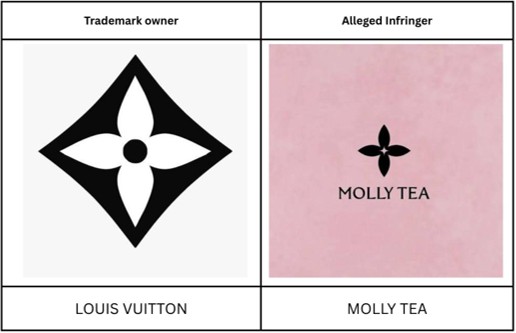
The recent first-instance judgment in Louis Vuitton Malletier v. Molly Tea has become one of the most closely watched trademark disputes in China in 2026. The case attracted widespread public attention not only because it involved one of the world’s most recognised luxury fashion houses and a rapidly expanding premium tea chain, but also because it raised broader questions about the protection of famous trademarks and the extent to which traditional design elements may be used in modern branding.
Much of the public discussion focused on a simple question: Can Louis Vuitton claim exclusive rights over a four-petal flower? While this framing generated significant debate on social media, it does not accurately reflect the legal issues before the court.
From a trademark law perspective, the dispute was never about ownership of a floral motif or traditional cultural design. Instead, the court was required to determine whether Molly Tea’s logo infringed Louis Vuitton’s earlier registered trademarks and whether the reputation of those marks justified broader legal protection under Chinese trademark law.
Although the judgment remains subject to appeal, it provides valuable insight into how Chinese courts assess trademark similarity, protect well-known trademarks, and balance commercial competition with the rights of trademark owners. More importantly, the case serves as a timely reminder that effective trademark strategy begins long before a product reaches the market.
This article examines the legal principles underlying the decision and highlights five practical lessons that businesses should consider when creating, adopting, and protecting their brands in China.
Case Background
Louis Vuitton Malletier (“Louis Vuitton” or “LV”) is internationally recognised for its luxury goods, including handbags, leather products, apparel, and accessories. Central to its brand identity is the iconic Monogram Canvas, which incorporates distinctive floral device marks that have been extensively used and promoted for decades. Through continuous commercial use and substantial investment in branding, these device marks have become closely associated with Louis Vuitton in the minds of consumers worldwide.
Molly Tea (茉莉奶白) is a Chinese premium tea brand specialising in jasmine-based beverages. As the company expanded its operations across China, it adopted a four-petal floral logo for use on store signage, packaging, promotional materials, and digital marketing channels.
Louis Vuitton subsequently initiated trademark infringement proceedings, alleging that Molly Tea’s logo was confusingly similar to several of LV’s registered device trademarks. According to publicly available reports, Louis Vuitton argued that Molly Tea’s continued use of the logo was likely to create consumer association with the Louis Vuitton brand, dilute the distinctiveness of its famous trademarks, and unfairly benefit from the goodwill attached to those marks.
In June 2026, the Suzhou Intermediate People’s Court ruled in favour of Louis Vuitton. The court ordered Molly Tea to cease using the disputed logo, publish corrective statements to mitigate the effects of the infringement, and pay RMB 10.3 million in damages and reasonable enforcement costs. Molly Tea has publicly stated that it intends to appeal the judgment, meaning the decision has not yet become legally final.
While the appellate proceedings may further clarify the court’s reasoning, the first-instance judgment has already become a significant reference point in discussions concerning the protection of well-known trademarks in China. Beyond the dispute between the parties, the case provides useful guidance on how Chinese courts approach trademark similarity, consumer perception, and cross-industry brand protection in an increasingly competitive marketplace.
The Legal Framework Under Chinese Trademark Law
The Louis Vuitton v. Molly Tea dispute cannot be understood solely by comparing the visual appearance of two logos. Rather, the case is grounded in several well-established principles of Chinese trademark law that govern the registration, use, and enforcement of trademarks. Although the full reasoning of the first-instance judgment has yet to be publicly released, the decision reflects the broader legal framework established under the Trademark Law of the People’s Republic of China and the judicial practice of Chinese courts.
At its core, trademark law is intended to protect signs that distinguish the commercial source of goods or services. Unlike copyright, which protects original artistic expression, trademark law focuses on a mark’s commercial function—namely, enabling consumers to identify the origin of products and distinguish them from those of competing businesses. The objective is not to reward creativity for its own sake, but to prevent consumer confusion and safeguard the goodwill that businesses develop through the consistent use of their brands.
China adopts a first-to-file trademark system, under which exclusive rights generally arise upon successful registration with the China National Intellectual Property Administration (CNIPA). Registration grants the trademark owner the exclusive right to use the registered mark in relation to the approved goods or services and to prevent unauthorized use that is likely to infringe those rights. This system underscores the importance of securing trademark protection at an early stage, particularly before launching a new brand or entering the Chinese market.
In determining whether trademark infringement has occurred, Chinese courts do not examine individual design elements in isolation. Instead, they consider the overall visual impression created by the marks, taking into account their appearance, distinctiveness, and the perception of the relevant public. The central question is whether the later mark is likely to cause consumers to believe that the goods or services originate from the same undertaking or from businesses that are economically connected.
The law also recognises that certain trademarks have acquired exceptional commercial reputation through long-term use and extensive public recognition. These well-known trademarks may receive broader protection than ordinary marks, including in circumstances involving dissimilar goods or services where the later use is likely to mislead the public, create an association with the famous mark, or impair its distinctiveness. Such protection reflects the principle that the value of a famous trademark extends beyond the products on which it is traditionally used.
Against this legal backdrop, the Louis Vuitton v. Molly Tea dispute illustrates that trademark infringement is assessed through a holistic analysis rather than a mechanical comparison of individual design features. The case therefore provides an opportunity to revisit several important principles of Chinese trademark law and offers practical guidance for businesses seeking to develop, protect, and enforce their brands.
Lesson One: Trademark Law Protects Commercial Identity, Not Artistic Concepts
One of the most common misconceptions arising from the Louis Vuitton v. Molly Tea dispute is that the case concerns ownership of a four-petal flower. This perception has fuelled much of the public debate, with some commentators arguing that floral motifs have long appeared in traditional Chinese decorative art and therefore should remain freely available for public use.
From a legal perspective, however, this argument misunderstands the purpose of trademark law.
Trademark protection does not grant exclusive rights over abstract ideas, artistic styles, or cultural motifs. Instead, it protects a sign that functions as a commercial identifier. The issue before the court was therefore not whether flowers have historically existed in Chinese culture, but whether Molly Tea’s logo, when used in commerce, created an overall commercial impression that was sufficiently similar to Louis Vuitton’s earlier registered trademarks.
This distinction is particularly important because many trademarks incorporate common design elements such as stars, leaves, crowns, geometric patterns, or flowers. These individual elements remain available for public use. What receives legal protection is the specific combination, stylisation, and commercial significance that consumers have come to associate with a particular brand.
For businesses, the practical implication is clear. A logo inspired by historical, cultural, or public-domain artwork is not automatically immune from trademark infringement claims. Even where the underlying design concept is widely recognised, the final commercial expression must still be assessed against existing trademark rights.
Our View
The widespread public discussion surrounding this case demonstrates how easily trademark law is confused with copyright or design rights. While the origin or originality of a design may be relevant in other areas of intellectual property law, trademark disputes focus on consumer perception and market function. Businesses should therefore evaluate a proposed logo not by asking whether its design elements are “original,” but whether the overall mark may create an unintended association with an existing registered trademark.
Lesson Two: Famous Trademarks May Enjoy Protection Beyond Their Traditional Markets
A second notable feature of the dispute is that the parties operate in different industries. Louis Vuitton is internationally recognised for luxury fashion and leather goods, whereas Molly Tea is a premium beverage company. To many observers, the absence of direct competition appeared to weaken Louis Vuitton’s claim.
Chinese trademark law, however, does not treat differences in product categories as conclusive.
While trademark rights are generally exercised in relation to the goods and services for which a mark is registered, the law recognises that well-known trademarks may warrant broader protection. This reflects the commercial reality that highly reputable brands often possess value extending far beyond their original products. Consumers today are accustomed to established brands expanding into new sectors through licensing, collaborations, lifestyle products, hospitality, and other commercial ventures. As a result, the use of a similar mark in a different industry may still lead consumers to believe that there is some form of commercial relationship between the businesses.
For well-known trademarks, courts may therefore consider not only the similarity of the marks themselves, but also the reputation of the earlier mark, the likelihood of consumer association, and whether the later use takes unfair advantage of the goodwill established by the trademark owner. Although the complete reasoning of the Louis Vuitton judgment has yet to be published, the outcome indicates that the court considered the reputation and distinctiveness of Louis Vuitton’s device marks to be significant factors in its assessment.
Our View
One of the most valuable lessons from this dispute is that trademark clearance should not be confined to a company’s own industry. Businesses frequently focus their searches on direct competitors while overlooking famous trademarks outside their immediate market. This approach may underestimate legal risk, particularly where a proposed logo resembles a mark with substantial public recognition.
As consumer brands increasingly diversify across industries, trademark disputes involving cross-sector businesses are likely to become more common. Companies should therefore adopt a broader risk assessment when developing new branding, taking into account not only existing registrations within the same class but also highly distinctive marks that may receive enhanced protection under Chinese law.
Lesson Three: Similarity Is Determined by Overall Commercial Impression
Trademark disputes are rarely resolved by placing two logos side by side and identifying individual differences. Instead, Chinese courts generally assess the overall commercial impression created by the competing marks from the perspective of the relevant public.
This principle recognises that consumers do not analyse logos with the precision of designers or trademark examiners. Purchasing decisions are often made quickly, and consumers rely on their overall recollection of a brand rather than a detailed comparison of individual design features. Consequently, minor variations in shape, proportion, or decorative detail may not be sufficient to eliminate the likelihood of confusion or commercial association if the marks convey a similar overall impression.
The Louis Vuitton v. Molly Tea dispute illustrates the importance of evaluating trademarks holistically. Rather than asking whether the logos are identical, courts consider whether the later mark is capable of leading consumers to believe that the products originate from, are endorsed by, or are otherwise connected with the owner of the earlier registered trademark.
Our View
Businesses should avoid assessing trademark risk solely through visual comparison. A logo that appears sufficiently different during the design process may nevertheless create a similar commercial impression once used in the marketplace. Obtaining legal advice before adopting a final brand identity is often considerably less costly than defending infringement proceedings after commercial launch.
Lesson Four: Trademark Refusals Should Be Treated as Early Warning Signs
Public reports indicate that trademark applications filed by Molly Tea incorporating similar floral device marks had previously encountered objections during the examination process before the China National Intellectual Property Administration (CNIPA).
Although the refusal of a trademark application does not automatically establish infringement, it should never be regarded as a procedural inconvenience. Instead, it signals the existence of earlier rights that may present significant legal obstacles if the proposed mark is subsequently used in commerce.
For many businesses, substantial investments in marketing, store expansion, packaging, and consumer recognition occur only after a trademark has been selected. If legal concerns identified during examination are not adequately addressed, the financial and operational consequences of a later infringement action may be considerably greater than the cost of redesigning the mark at an earlier stage.
Our View
Trademark examination should be viewed as part of a broader risk management strategy rather than an isolated administrative process. Where objections arise because of similarities with earlier registrations, businesses should carefully reassess their branding strategy before committing to large-scale commercial use.
Lesson Five: Effective Brand Protection Begins Before Launch
Many trademark disputes become highly visible only after a brand has achieved commercial success. By that stage, however, changing a logo may require replacing packaging, advertising materials, store signage, digital platforms, franchise documentation, and other branding assets, often at considerable expense.
The Louis Vuitton v. Molly Tea dispute demonstrates why trademark protection should be integrated into the earliest stages of brand development. Comprehensive clearance searches, legal review, and strategic portfolio planning can significantly reduce the likelihood of future disputes while strengthening the long-term value of a company’s intellectual property.
For growing businesses, trademark strategy should be viewed not merely as a legal requirement but as an investment in sustainable brand development.
Practical Implications for Businesses
The Louis Vuitton v. Molly Tea decision provides several practical lessons for businesses operating in China:
- Conduct comprehensive trademark clearance searches before adopting a new brand or logo.
- Assess potential conflicts beyond your immediate industry, particularly where famous trademarks are involved.
- Evaluate the overall commercial impression of a proposed logo rather than focusing on individual design differences.
- Treat CNIPA examination objections as early indicators of legal risk.
- Integrate trademark protection into broader business strategy, particularly before expansion, franchising, or significant marketing investment.
Proactive trademark management remains significantly less expensive than defending infringement proceedings or undertaking a large-scale rebranding exercise after commercial success has been achieved.
Conclusion
Although the Louis Vuitton v. Molly Tea dispute remains subject to appeal, the first-instance judgment has already become an important example of how Chinese courts approach the protection of well-known trademarks. More importantly, it illustrates that trademark infringement is not determined by isolated design elements or artistic inspiration, but by the commercial function of a mark and the overall impression it creates in the minds of consumers.
For businesses, the decision reinforces the importance of adopting a proactive approach to brand protection. Effective trademark strategy extends beyond filing applications; it requires careful planning, comprehensive clearance, and an understanding of how trademarks operate within the marketplace. As Chinese brands continue to expand and international businesses strengthen their presence in China, disputes involving distinctive visual identities are likely to become increasingly common.
Ultimately, the Louis Vuitton v. Molly Tea case serves as a reminder that trademarks are among a company’s most valuable commercial assets. Investing in sound trademark strategy from the outset is not simply a matter of legal compliance—it is an essential component of protecting brand value, reducing commercial risk, and supporting long-term business growth.