Case type: Successful invalidation of an EU “prior design” registration
Result: Client’s product cleared for EU market entry
The Situation
In May 2025, our client planned to launch a mushroom lamp in the EU market. Before exporting, they asked us to run an IP risk assessment a standard compliance step for any product entering Europe.
The search turned up a problem: an existing EU design patent looked very similar to the client’s product. Left unresolved, this could have meant:
- Goods detained at EU customs
- Potential litigation
- Liability for damages
What We Found
We dug deeper into the EU design’s legal foundation — and found it wasn’t as solid as it looked.
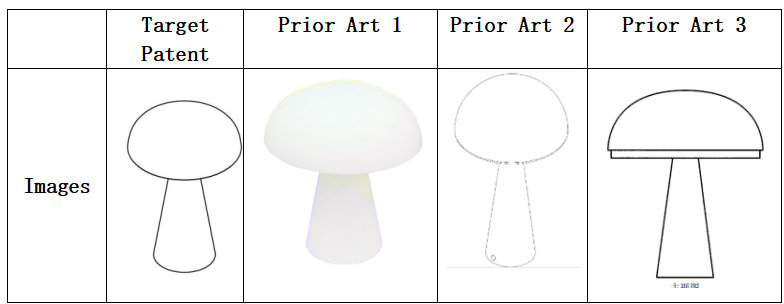
Before the EU design’s application date, nearly identical mushroom lamp designs had already been publicly available in China and Brazil. That’s a critical detail. Under EU design law, a design only qualifies for protection if it’s genuinely new — meaning no identical or substantially similar design existed publicly, anywhere in the world, before the filing date.
Since that condition wasn’t met, the registered EU design lacked the novelty required to be valid in the first place.
What We Did
Based on this evidence, our team built a “proactive invalidation” strategy instead of waiting to be sued. We filed a design invalidation application directly with the European Union Intellectual Property Office (EUIPO) — clearing the legal obstacle before the client’s product ever launched.
The Outcome
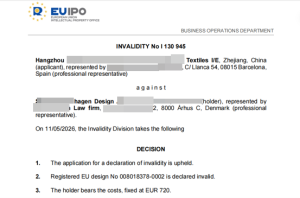
The EUIPO agreed with our evidence and arguments. It invalidated the design under:
- Article 25(1)(b) of the EU Design Regulation
- Combined with Articles 4(1) and 5(1)(b)
The disputed design was struck down. Our client’s product entered the EU market without further legal risk.
Why This Matters: The Legal Basics
Novelty is required for a valid EU design registration. Under Article 5 of the EU Design Regulation, a design counts as “novel” only if no identical or near-identical design was made public anywhere in the world before its filing (or priority) date.
“Made public” covers a lot of ground, including:
- Sales on domestic or overseas e-commerce platforms
- Posts on social media or design websites
- Trade show exhibitions
- Print publications
If any of these happened before the design’s filing date, the design loses its novelty — and stays vulnerable to invalidation, even after registration.
There’s a 12-month grace period — but it has limits. Article 7 of the EU Design Regulation protects an applicant’s own disclosures made within 12 months before filing. In this case, though, the earlier disclosure came from a third party, not the design’s applicant — so the grace period didn’t apply, and the design remained exposed.
The Bigger Lesson for Exporters
If a pre-export IP search turns up a blocking design, don’t assume it’s a dead end. Check whether that design’s rights are actually solid.
Two paths when you hit a blocking IP right:
- Reactive: Wait to get sued, then respond — usually more expensive and harder to control on a timeline
- Proactive: Investigate the right’s validity now, and file for invalidation before you ever launch — often cheaper, faster, and removes the risk entirely
Many Chinese companies facing an overseas “patent ambush” default to conceding — paying licensing fees or walking away from the market. But our experience says that’s often not necessary.
The real determining factor in these disputes usually isn’t who filed first — it’s whether that filing can actually hold up. A meaningful share of “prior rights” we investigate turn out to have shaky legal foundations: missing novelty, or failing to meet other registration requirements. Uncovering that takes professional searching and analysis, backed by solid facts and timely action.
In this case, we removed a legal obstacle standing between a mushroom lamp and the EU market. The underlying approach is the same in every case: use professional analysis and legal process to protect the commercial space that rightfully belongs to our client.
Facing an IP obstacle in your own overseas expansion? Get in touch — the situation may not be as difficult as it first appears.
Appendix: EU Invalidation Decision