


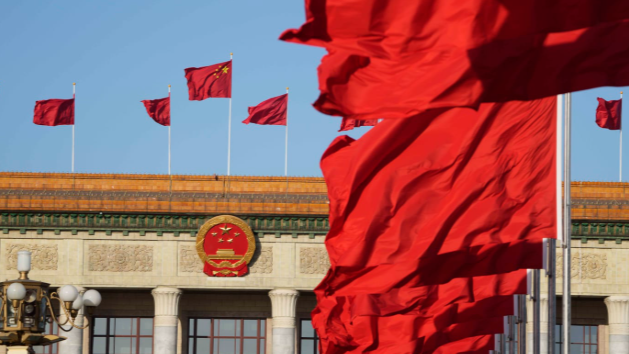
Chinese national flags outside the Great Hall of the People in Beijing. Photo: VCG / Getty Images
China’s trademark overhaul has dominated headlines this year, but a quieter shift is underway in copyright. The Copyright Law itself hasn’t changed since 2020. What is changing is the rulebook beneath it, the Implementing Regulations, along with a fast-growing body of court decisions on AI-generated content, streaming-era media and accessibility.
At a glance
- Draft released: July 13, 2026, by the National Copyright Administration (NCA)
- Public comment period: closed August 12, 2026
- What’s changing: the Implementing Regulations, not the Copyright Law itself
- Length: from 38 articles to 49
- Last revised: 2013
- Status: draft, final version pending
Why the update is happening now
Two things forced it. First, the Copyright Law’s third amendment took effect in June 2021, but the 2013 regulations were never updated to match, leaving five years of gaps and outdated cross-references. Second, China has since joined the Beijing Treaty on Audiovisual Performances and the Marrakesh Treaty, which requires accessible formats for blind and print-disabled readers. Neither is reflected in the current rules.
Key changes in the draft
A modern definition of “audiovisual work.” The current wording refers to works made by methods analogous to filmmaking, which predates streaming. The draft replaces it with a technology-neutral category covering films, TV dramas, documentaries, animation, web series and variety shows. This matters for foreign media, gaming and streaming companies, because it removes doubt over whether online-native content qualifies.
A presumption of ownership. Draft Article 9 presumes the person named on a work owns the copyright, unless proven otherwise. That should make it easier to establish standing in disputes, which helps foreign rights holders, since copyright in China doesn’t require registration.
First detailed rules on technical protection measures. New Articles 43 to 46 set out a framework for technical protection measures (TPMs) and rights management information. They:
- define technical measures and require rights holders to label them
- allow an accessibility exception, so reading-disabled persons who can’t otherwise access a work may request circumvention tools
- exclude measures that compromise network or data security, or harm the public interest without a genuine copyright purpose
- define rights management information for the first time
For companies using DRM, watermarking or licensing metadata in China, this gives those measures legal backing, but also clear limits.
New protections for performers. Reflecting the Beijing Treaty, producers keep the rights in a film or TV performance, but performers keep the right to be identified, the right to object to distortion, and a contractual right to remuneration.
A new standard for fines. The draft replaces fixed penalty formulas with a list of what counts as harm to the public interest, such as damaging the national image, disrupting market or cultural order, or profit-driven, habitual infringement. It will take case law to define these terms.
AI and copyright: the courts are leading
Alongside the draft, Chinese courts have been building AI copyright law through decisions, not legislation:
| Date | Development |
| 2019 | Beijing Internet Court holds that only natural persons can create copyrightable works, denying protection to a purely AI-generated report |
| 2023 | Beijing Internet Court finds that prompt selection, arrangement and parameter choices can make an AI image copyrightable, a designated “typical case” |
| October 2025 | Supreme People’s Court removes AI copyright cases from the specialized Internet Courts and sends them to ordinary local courts |
| February 2026 | Guangzhou Internet Court issues a verdict on AI-generated images that reproduced the Ultraman character library |
| May 2026 | A Guangzhou court delivers China’s first criminal conviction for copyright infringement involving AI-generated content, over more than 1,700 AI-created short dramas |
The practical result: Chinese courts will generally protect AI-assisted works when a human contributed genuine creative input, but won’t protect purely automated outputs, and will treat outputs that copy protected characters or IP as infringing.
What this means for your business
- Watch for the final version. The comment period has closed, so monitor the NCA for the finalized text, especially the TPM circumvention exception and the public-interest harm standard.
- Audit your DRM and watermarking against the new technical-measures framework.
- Document human creative input in AI-assisted content made for China, including prompt design, selection and arrangement, as it may become your evidence of ownership.
- Treat AI training and output infringement as live litigation risk, not a legal gray area.
- Review contracts with China-based performers and producers in light of the new attribution and remuneration protections.
Need help?
Tranfan Law Office advises foreign companies on IP protection and enforcement in China.